Problem: your service page says what you do, but gives people little reason to choose you
A service page can have a logo, a list of services, and a contact button and still leave the important questions unanswered. Does this business understand my situation? What are my options? Why should I pay for this particular approach?
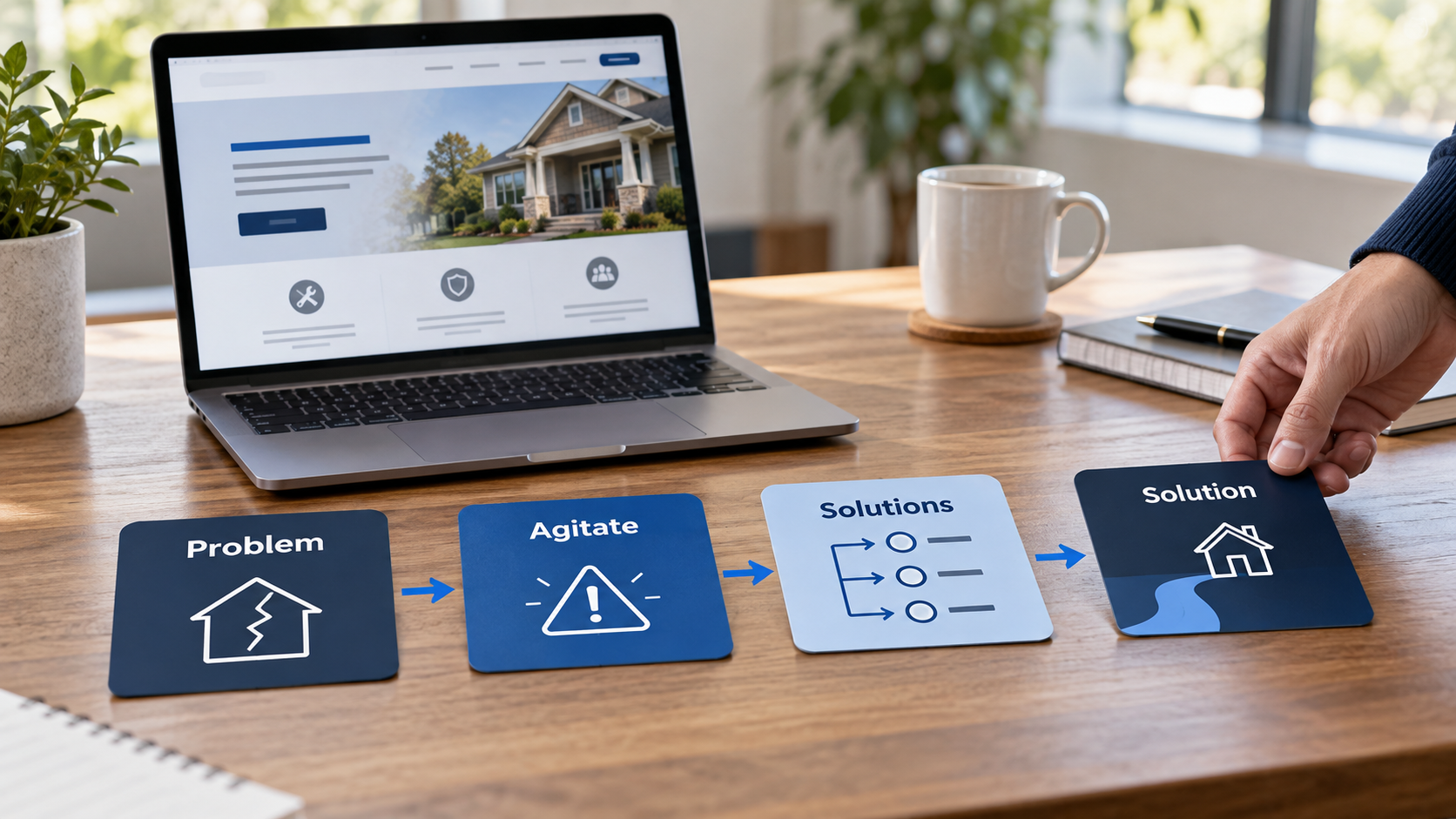
My view is that a service page should help customers make a decision. The PASS method gives that conversation a useful order: Problem, Agitate, Solutions, Solution.
The distinction between the last two steps matters. First, explain the different approaches a customer could take and their tradeoffs. Then present your business’s solution and show why it fits. Skipping the comparison makes your recommendation harder to assess.
This article follows that same structure. The problem is an unconvincing service page. Next comes what that costs the visitor, the options for fixing it, and the approach I recommend.
Agitate: unanswered questions make the customer do the work
Imagine a homeowner looking for help with a stained driveway. One website says “quality pressure washing at affordable prices.” Another explains which surfaces the company cleans, how it assesses the job, and what the homeowner can expect.
The first page asks the visitor to fill in the gaps. They may need to call just to discover whether the service is suitable. Or they may leave and compare another company.
A page like that can weaken the value of the visits you already earn through referrals, search, or advertising. It doesn’t prove that every visitor would have become a customer. It does create avoidable uncertainty at the point where someone is deciding whether to inquire.
That is what the Agitate step should do: make the practical consequences clear. You don’t need to invent a disaster. Explain the extra effort, continued frustration, or unresolved issue that makes the problem worth addressing.
Solutions: compare the ways you could improve the page
You have several reasonable options. Each can help, but each solves a different part of the problem.
Rewrite it yourself
You know your customers and your work. Writing your own page can be a sensible choice if you have time and can step back from the business’s internal language.
The drawback is familiarity. Details that feel obvious to you may be exactly what a new customer needs explained. Start with questions people actually ask before hiring, and have someone outside the business read the result.
Start with a template
A template can give you a usable layout and stop you staring at an empty page. It is helpful when the main obstacle is getting started.
However, a template cannot supply your reasons to choose the service. Generic claims, borrowed wording, and placeholder testimonials won’t explain your process. You still need accurate details and evidence from your business.
Use AI to produce a first draft
AI can help organize rough notes or suggest different ways to explain a service. It can also produce confident claims that don’t match what you offer.
Check every statement about scope, pricing, timelines, qualifications, and results. A polished paragraph is only useful if it is true. Give the draft real customer questions and service details instead of asking for a page that merely sounds persuasive.
Redesign the page without changing its message
Better spacing, clearer headings, readable type, and a mobile layout can make a page easier to use. Those improvements matter.
But a new layout won’t answer a question the copy never addresses. If the message is vague, rearranging it gives you a better-looking version of the same uncertainty.
Solution: use the PASS method to build the argument before polishing the page
I recommend planning the customer’s decision first, then designing the page around it. The PASS method helps you connect the problem, the alternatives, and your recommendation instead of assembling disconnected sections.
Here is how that could work for a hypothetical pressure washing service page. These are planning examples, not claims about a real company.
Problem: name the situation the customer recognizes
“Your driveway has dark stains that an ordinary rinse isn’t removing.” That gives the visitor something specific to recognize. It is more useful than opening with a long company history.
Describe the problem your service actually addresses. Don’t promise that one process fixes every type of stain or surface.
Agitate: explain why the problem deserves attention
“You’ve spent time trying to clean it, but the entrance still looks neglected.” This connects the problem to frustration and appearance without inventing damage or a safety emergency.
Use consequences you can support. The purpose is to help customers judge the importance of the job, not pressure them through fear.
Solutions: acknowledge the alternatives honestly
The homeowner could try another household cleaner, rent equipment, or hire a company. Explain the relevant tradeoffs: time, equipment setup, surface knowledge, and the limits of the method.
Don’t pretend every DIY attempt fails or every competitor cuts corners. An honest comparison makes it easier for someone to decide whether your service is appropriate.
Solution: show how your service addresses those tradeoffs
Now explain your actual approach: how you assess the surface, what is included, what preparation is needed, and how you discuss stains that may remain. Only include steps your business really follows.
Support the explanation with real project photos, relevant customer feedback, and clear service boundaries. Then offer one obvious next step, such as requesting an estimate.
Turn the framework into a usable service page
You don’t have to label the live page “Problem” and “Agitate.” Those are planning prompts. Customer-facing headings should make sense to someone looking for help.
- Open with the service and the problem it solves.
- Explain the consequences briefly and proportionately.
- Compare the meaningful options and their drawbacks.
- Describe your approach, scope, and supporting proof.
- Make the next step easy to find and complete on a phone.
Keep the page focused on one service and its customer. A complex job may need more explanation than a simple one. PASS is a structure for clear reasoning, not a requirement to make every page long.
The inquiry itself needs attention, too. Our website lead generation service looks at the path from a visit to an inquiry, including what visitors see and what you ask them to do next.
Give customers a reason to choose your approach
I’m in favor of the PASS method because it makes your recommendation earn its place. Show that you understand the problem, explain why it matters, compare the options fairly, and demonstrate why your solution fits.
DeVoy Marketing can help organize your service page around those decisions, with clear copy, a usable layout, and a direct path to an inquiry. We start with what your business actually offers and the questions customers need answered.
If your website describes your services but leaves the case for choosing you unfinished, let’s review it.